
Local Processing (as a service)
and its various renditions!


As companies go global, they encounter the challenge of adhering to disparate local regulations, like the same company would be subjected to different laws in India, than in Indonesia. This misalignment of local norms complicates global operations and increases costs of doing business, highlighting the complexity of managing a global presence in a locally diverse regulatory environment.
Enter Local Processing. Local processing ensures that local guidelines are properly followed. However, it's challenging for global organizations to set up entities in every country they operate in, creating a large operational burden and this is where Local Processing as a service comes in. I did my own (Socratic) examination of the use cases I’ve seen over time and connected the dots, looking backwards.
Remittances (WISE, Remitly etc.) – Sending money internationally can be expensive because banks charge high fees, especially for retail customers. This is due to their regulatory capture over the SWIFT system, which only banks can use to transfer money overseas. As a result, banks make super-normal profits, and customers pay high prices. Enter Local Processing. Solutions like WISE and Remitly address this by maintaining local pools of money (in domestic currencies) and doing local transactions to transfer money from the sender to the receiver.
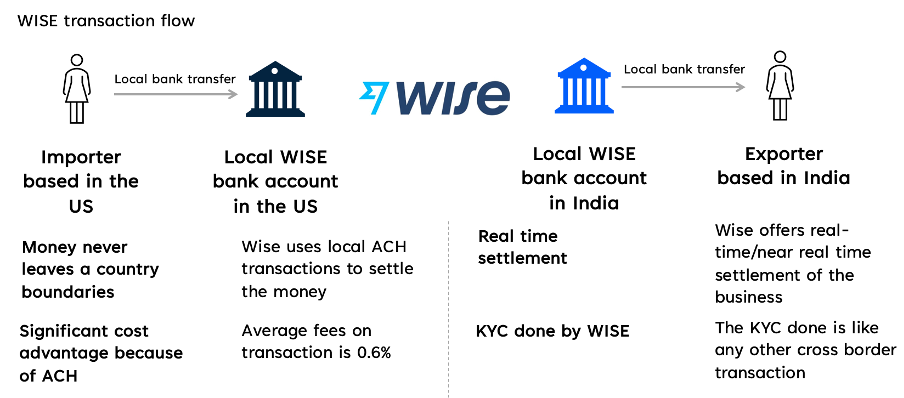
One quote that I often think about is from Kristo, Co-Founder of WISE: "The best way to move money overseas is to not move money at all." Solutions like WISE and Remitly embody this, and the advantages are clear:
Customer Advantage: WISE customers pay around ~0.6- 0.9% in average fees compared to the 2-4% charged by traditional banks.
High Gross Margin: Since WISE only does local transactions, which are inexpensive and a commodity in most countries, they maintain high gross margins of 60-70% while offering much (orders of magnitude) cheaper rates to customers.
Near-Real-Time Settlement: Domestic transactions are efficient. A SWIFT transfer can take 3-5 days and is often opaque, but with WISE, the settlement is almost instantaneous (~90 pc of all WISE transactions settle in one day), greatly enhancing the user experience.
The business model has obvious challenges around working capital management but it is a superior product for people.
Payment Processing (like Lemon Squeezy, Paddle; my favourite rendition of Local Processing) – There's been a noticeable increase in companies selling their products and services globally, from D2C brands to game studios to SaaS companies. Take an Indian company trying to sell overseas, for instance. The only option they have is to use an Indian payment gateway. This setup brings about three major issues.
Firstly, processing foreign payments through Indian payment gateways is incredibly expensive. To give you an idea, Stripe in India charges around 5-7% in MDR for handling overseas card payments for Indian merchants. That's a significant chunk of money lost to transaction fees.
Secondly, the payment success rates are dismally low. This happens because the issuing banks (the customers' banks) don't trust the foreign merchant, leading to a lot of declined payments. We're talking about success rates below 30%, which is a stark contrast to local payments that typically have success rates around 90%. Imagine going through all the effort (and cost) to convert a customer, getting them to the checkout page, and then the payment fails. It's painful.
Additionally, we're seeing a clear dominance of real-time payment systems (RTPs) across the globe. These systems are becoming the norm. However, if you're using an Indian company using an Indian payment gateway to process domestic transactions in another country, you won't be able to offer the RTPs of that country (say, PIX in Brazil).
To offer RTPs, you need a local payment gateway that can handle those transactions. Providing RTP at checkout is hygiene, today.
Enter Local Processing as a service, specifically through merchant-on-record (MoR) solutions. These platforms, like Paddle, Lemon Squeezy, act as the official merchant on record in the country where you're selling. They set up a network of local entities, enabling them to process payments locally. This means they can offer real-time payments (RTPs), provide a wider range of payment options, and most importantly, achieve significantly better payment success rates.
Using these MoR solutions is also much cheaper. For example, a domestic transaction typically costs between 2-3% in merchant discount rates (MDR) almost everywhere in the world, plus an additional 0.5-1.0% for repatriating money to the merchant. This is still 40-50% cheaper than using a local payment gateway for global payments, which can cost between 5-7%.
This allows you to offer: a) local payment options that the customers are familiar with; b) better payment success rates because of domestic transactions and a local PG; c) no burden of complying with the local laws. Again, an inherent superior solution.
Building Global Teams (Deel, Multiplier, Remote) - Imagine you are a Series C/D funded company ready to go global and hire in various geographies. What do you do? You need to set up entities worldwide to ensure that employees are properly housed in each country. Each of these entities must adhere to local social security norms, offer local insurance to employees, and provide local perks. This creates a significant operational burden for any company, especially for young companies where these functions around human resource and compliance are still developing.
Enter Local Processing as a Service. We've seen the rise of companies like Deel (which became the fastest company ever to reach the coveted US $ 100.0 M ARR mark), Remote, Multiplier, and Rippling (which does much more, shoutout to Parker Conrad’s fascinating framework of a Compound Startup). These companies build the infrastructure—a web of entities across the globe. Global organizations then enlist these companies to manage their global workforce.
Here’s how it works: The global company pays these platforms, and the platforms handle everything else. They take care of local social security commitments, local insurance, and payroll management through their network of entities, locally in the country where the employee is. They also house the local employees, ensuring they receive proper benefits and perks. These platforms have back-to-back guarantees with the end employer, so they don’t carry any liabilities.
Local Processing as a service unlocks such clear advantages that make me think about where will this go next. If you are building or thinking about building in the space, I’d love to speak to you and learn more about you, and your journey. I am at satvik@quona.com
Disclaimer: The views are strictly my own, and not attributable to my employer.